
45th Anniversary Stories: Sheryl Cooper & Tom May
The Good Tern Co-op: Leadership and Local Resilience
An Interview with Sheryl Cooper & Tom May
by Paula Coyne
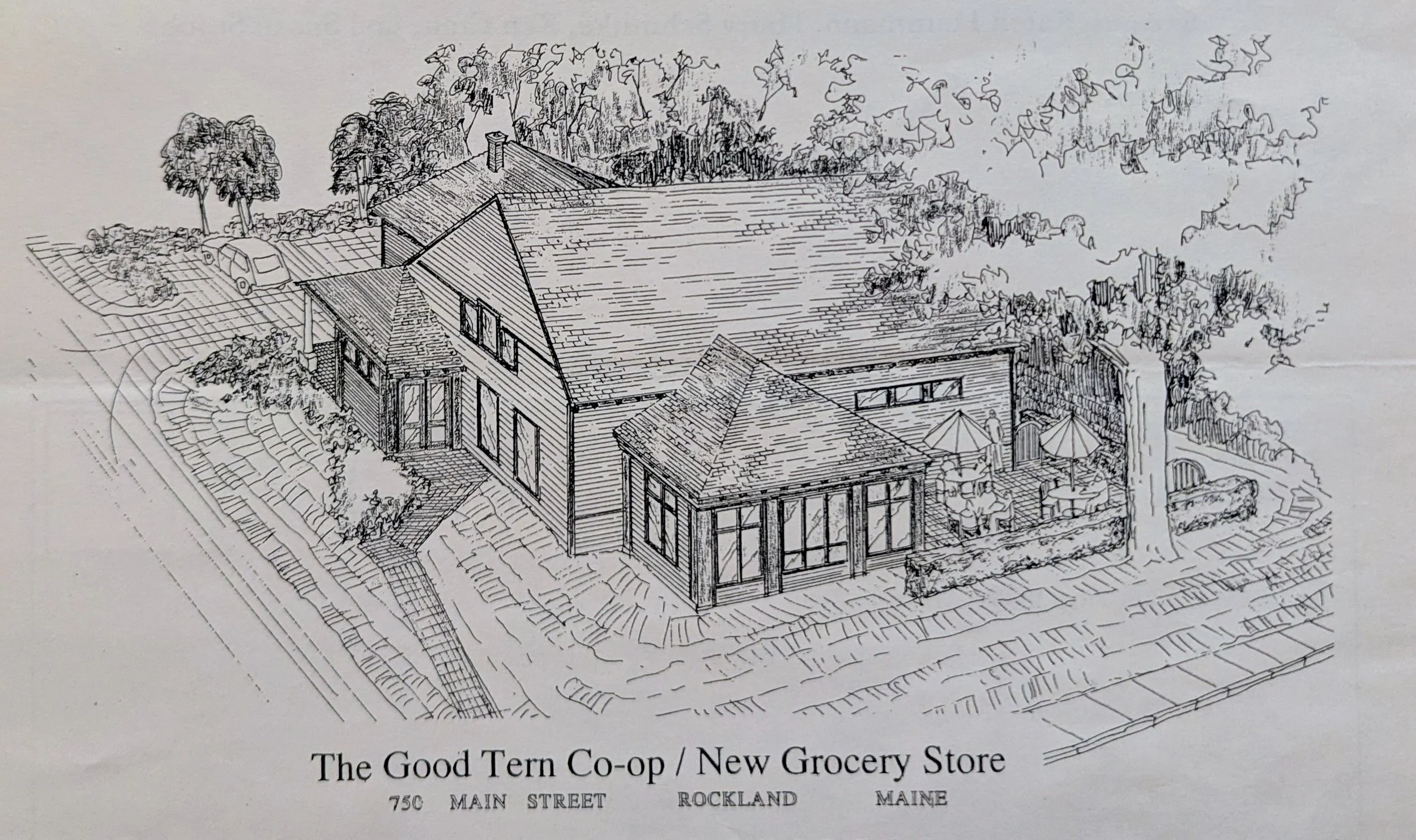
Good Tern Co-op’s “new grocery store”, designed by Robert. A. Davis Architect
The Good Tern Co-op (GTC) opened on Main St. in Rockland in 1980 in a nondescript storefront whose modesty hid a larger ambition: to be a steady, affordable source of groceries for a growing community. Initially managed by founding members Rochelle Garrett and Susy Ellis, Sheryl Cooper took the helm in 1988. At the time the co-op already carried a familiar ethos — careful pricing, reliable staples, and a sense that value and place mattered. Over the next thirteen years, Cooper would steer a deliberate transformation that extended beyond inventory. Under her leadership, GTC moved from a value-driven shop toward a rising commitment to organic offerings, strengthening not only product lines but the store’s role as a community hub.
The enterprise evolved into something more purposeful and enduring, a local institution whose gains were measured as much in relationships and stability as in stock turns. Location mattered in this evolution as much as leadership did. The store’s early days on Main Street provided a village-scale presence with a storefront that fit the town’s pedestrian pace and signaled a cooperative ethos. Cooper’s leadership during this period fused vision with arithmetic. The decision to shift toward organic offerings was framed less as a marketing gesture than as a core business decision anchored in quality and sustainability. Organic products expanded the co-op’s identity, but they required careful management of supply, margins, and shelf turnover.
Cooper’s approach to purchasing honed from her experience as the owner of a natural foods store in York, ME—streamlining the process, tightening margins, and ensuring a dependable quantity of stock—translated into a steadier cash flow. In a small store where every dollar must stretch, such financial discipline was not a cold calculus but a means to preserve access to higher-quality goods for a broader segment of the community. The co-op could grow without abandoning its promise of fair prices or its neighborly character because leadership harmonized sound budgeting with a taste for better product choices. The co-op’s governance included innovative arrangements for capital and risk-sharing. Founders who contributed start-up funds could recover their investment not in cash but in goods when cash was tight, a policy described by participants as “in kind” repayment. It was a practical solution to liquidity issues that sometimes constrained small enterprises in lean periods, preserving the co-op’s ability to keep shelves stocked and employees and volunteers engaged. The store’s volunteer corps—reliable, knowledgeable individuals who could operate the counter with professionalism—constituted a vital human capital layer. Their steady presence kept daily operations moving smoothly, even as the store navigated growth, seasonal fluctuations, and the complexities of expanding product lines.
The leadership dynamic during Cooper’s tenure extended beyond her own actions. The post-1988 framework included a prudent advisory backbone and a governance culture that valued continuity. Cooper’s collaboration with Ken Crane, who served for many years as Board Treasurer, provided a steady financial compass. Crane’s advice—anchored in decades of experience—helped shape budgeting, risk management, and the co-op’s long-range planning. Tom May, Cooper's husband, a Board member and currently a member of the finance committee, offered ongoing input on financial oversight and strategic direction. This network of steady guidance proved critical as the co-op’s strategic priorities evolved: the need to balance growth with stability, to preserve the cooperative ethos while expanding the store’s reach, and to align daily operations with the town’s changing demographics and expectations. The story of the Good Tern Co-op from 1988 through the early 2000s is thus a case study in how leadership, governance, and place intersect to shape a small, community-based enterprise. Cooper’s tenure demonstrates that a strategic shift toward higher-quality offerings can be realized within the constraints of a shoestring budget when paired with disciplined purchasing, flexible member-aligned financial practices, and a robust volunteer base. The voluntary and staff backbone — coupled with Ken Crane’s steady financial counsel and a supportive Board of Directors — provided the stability required to carry the co-op through transitions and growth periods.
The relocation from Main Street to Route 1 in 2004 did not merely accompany this transformation; it amplified it, turning the store into a more visible incubator for the co-op’s evolving mission. Looking ahead, the Good Tern Co-op narrative offers points of reflection for other small, community-based ventures. First, leadership that couples a clear product vision with operational discipline can expand a store’s identity without sacrificing accessibility. Second, governance that blends long-standing advice with ongoing involvement—what Crane, May and an involved Board represented for the co-op—serves as a critical backbone during periods of change. Third, place matters: location choices that increase visibility and ease of access can reinforce a store’s strategic aims and strengthen its social capital. The Good Tern Co-op’s trajectory demonstrates that a local enterprise can redefine its market position and deepen its community role not through one dramatic breakthrough but through a sequence of well-considered decisions about leadership, finance, and space.
In sum, the Good Tern Co-op’s history in Rockland—first on Main Street, and now on Route 1 — embodies a pragmatic, evidence-based approach to community-based retail. The area's ongoing investment—through volunteers, members, and engaged leadership has yielded a stable local institution. A co-op is more than a storefront; it is a living map of a community’s ambitions, and the Good Tern's map continues to chart a course toward sustainability, inclusivity, and shared abundance.